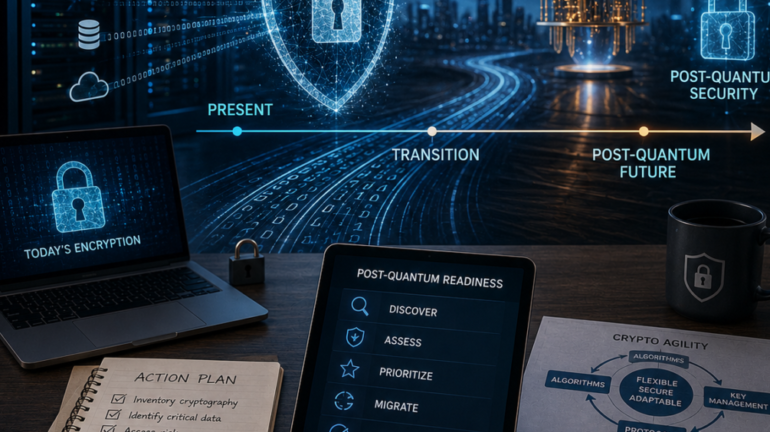

Post-quantum cybersecurity can sound like a problem for the distant future. Quantum computers are still developing, and most businesses are focused on threats they can see today, such as ransomware, phishing and stolen credentials.
But encryption has a long memory.
Data stolen today may still be valuable years from now. If attackers collect encrypted files now and store them, they could try to decrypt that information later when more powerful quantum computers become available. This is often called “harvest now, decrypt later.”
For organizations that hold information with a long shelf life, waiting for a quantum breakthrough before preparing could be too late.
Why Today’s Encryption Will Not Last Forever
Modern cybersecurity depends heavily on encryption. It protects online banking, private messages, software updates, business documents and countless connections between systems.
Some of the public-key encryption methods used today rely on mathematical problems that are extremely difficult for conventional computers to solve. A sufficiently capable quantum computer could change that.
This does not mean every encrypted system will suddenly become unsafe tomorrow. It means organizations need time to find where vulnerable cryptography is used and replace it carefully.
That is a much bigger job than installing a normal software update.
The Real Challenge Is Knowing What You Use
Most companies cannot immediately answer a simple question: where is cryptography used across the business?
It may be built into websites, cloud services, virtual private networks, certificates, mobile applications, databases, payment systems and equipment that has been running for years.
Some encryption is visible. Much of it is buried inside products supplied by other companies.
That is why NIST recommends beginning the move toward post-quantum cryptography now. A useful first step is building an inventory of systems, applications and data that rely on cryptographic protection.
You cannot replace what you do not know you have.
Not Every System Needs to Move at Once
Post-quantum cybersecurity is not about replacing every piece of encryption overnight.
Organizations should start with the information that would cause the most harm if exposed. Medical records, government information, intellectual property, financial data and long-term business secrets may need to remain confidential for many years.
A public marketing document obviously does not carry the same risk.
This kind of prioritization keeps the project practical. Security teams can focus first on systems protecting sensitive, long-lived information instead of treating every application as equally urgent.
Crypto-Agility Matters More Than One Algorithm
There is another lesson hiding inside the quantum discussion.
Organizations should make it easier to change encryption when security requirements change. This idea is often called crypto-agility.
Think of it as avoiding a situation where an old cryptographic method is so deeply built into a system that replacing it takes years.
NIST published updated guidance on cryptographic agility in 2026, emphasizing the need for organizations to adapt cryptographic mechanisms without causing major disruption.
That matters beyond quantum computing. Algorithms can weaken, standards can change and new vulnerabilities can appear.
A flexible system is easier to protect.
Vendors Need to Be Part of the Conversation
Businesses rarely control all of their technology.
Cloud providers, software companies, equipment manufacturers and other suppliers may manage some of the encryption an organization depends on. That makes vendor planning an important part of the transition.
Companies should ask suppliers whether their products support post-quantum standards, when upgrades will become available and what customers will need to do.
The goal is not to demand immediate replacement of everything. It is to avoid discovering too late that an important system cannot be upgraded easily.
This Is a Planning Problem, Not a Panic Problem
Quantum computing is often discussed with dramatic language. That can make the issue feel either frightening or too futuristic to take seriously.
Neither reaction is especially useful.
Businesses do not need to panic, and they do not need to predict the exact date when a cryptographically relevant quantum computer will arrive. They need to understand which information must stay protected, where current encryption is used and how difficult those systems will be to change.
That work has value even if the quantum timeline moves.
Start Before the Deadline Feels Urgent
The biggest risk may be assuming there will be plenty of time later.
Large organizations often take years to replace security technology, when older systems, outside vendors and regulated data are involved.
Post-quantum cybersecurity gives businesses a chance to prepare before migration becomes an emergency.
Start with visibility. Identify data. Map where cryptography protects it. Talk to vendors. Build systems that can adapt when standards change.
The future threat may come from quantum computers, but the work required today is familiar: understand your assets, reduce uncertainty and make security decisions before pressure takes over.
Contributed by GuestPosts.biz
Further Reading: Cyber Gear Thought Leadership Series